Kintamani, Bali · Small-group yoga & quiet retreats Enquire about a class
yogaesthetic

Start here

Yoga for beginners: your first month, without the guesswork

You do not need to be flexible, thin, calm or dressed correctly to begin. You need a mat-sized piece of floor, twenty minutes, and permission to be a beginner in public.

What most beginners actually worry about

Almost everyone arrives with the same three fears: that they are too stiff, that everyone will be watching, and that they will not know what to do. All three are reasonable, and all three dissolve in the first ten minutes of a decent class.

Stiffness is not a disqualification — it is the reason to practise. Nobody is watching, because the room is full of people managing their own balance. And not knowing what to do is expected; that is what a teacher is for.

The one thing worth unlearning early: yoga is not a performance. There is no audience, no score, and no version of a posture you owe anyone.

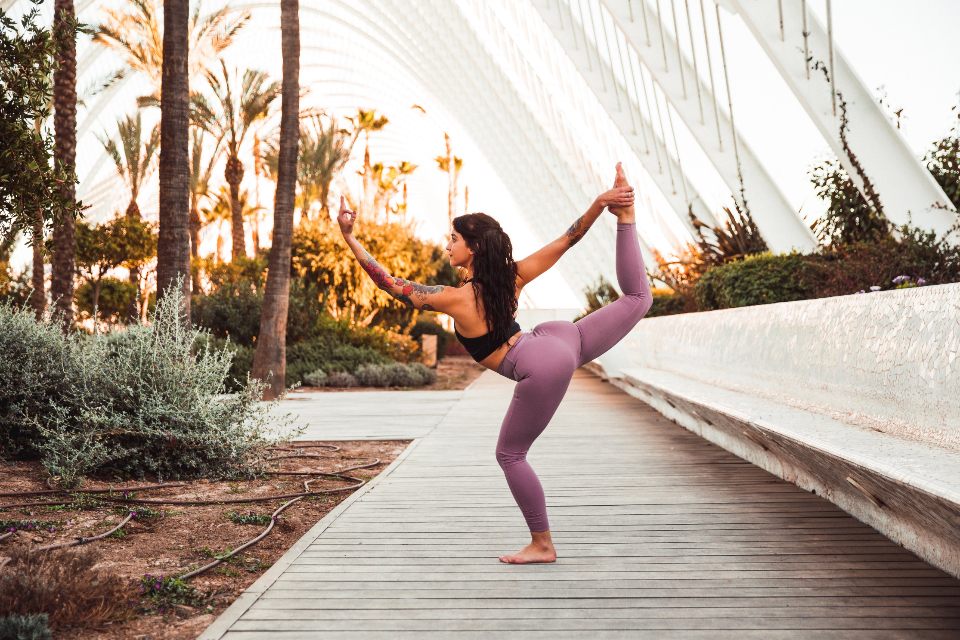
A practitioner in a standing backbend on a wooden boardwalk lined with palms

Comfortable seat, ordinary breath — the whole of the beginning

Practicalities

What to wear, bring and expect

01 / Clothing

Wear what stays put

Fitted but not tight is the practical rule: leggings or shorts that do not ride up, a top that does not fall over your face in a forward fold. Skip belts, big jewellery and anything you would mind sweating in. Bare feet, always.

02 / Equipment

A mat and two blocks

That is genuinely enough. A blanket substitutes for a bolster; a stack of books substitutes for blocks at home. Our studio provides mats, blocks and blankets, so on your first visit you need only yourself and water.

03 / Timing

Not on a full stomach

Leave roughly two hours after a meal, or have something small an hour before. Practising hungry is distracting; practising recently fed is worse. Sip water before and after rather than gulping through the class.

04 / Expectations

You will not be good at it

Not in the first class, and that is the correct experience. Expect to wobble, to need the wall, and to find at least one instruction that makes no sense until the third attempt. That is normal learning, not failure.

A twenty-minute routine you can do today

Move slowly, breathe through your nose, and stop if anything pinches. Ten to fifteen breaths in each posture is plenty. This is a routine for waking the body up, not for achieving anything.

  1. Seated breath — 2 minutes. Sit cross-legged on a cushion. Let the spine rise and the shoulders drop. Breathe in for four, out for six. Notice where you are holding tension, without fixing it yet.
  2. Cat–cow — 8 rounds. On hands and knees, alternate rounding and arching the spine with the breath. Move from the mid-back, not the neck. This is the warm-up that makes everything else possible.
  3. Downward-facing dog — 5 breaths, twice. Hands shoulder-width, hips high, knees generously bent. The aim is a long spine, not straight legs. Pedal the feet if the calves complain.
  4. Low lunge — 5 breaths each side. Step one foot forward between the hands, lower the back knee, and let the hips sink. Support the knee on a blanket. Keep the front knee over the ankle rather than past the toes.
  5. Warrior II — 5 breaths each side. From the lunge, turn the back foot out, extend both arms, and look over the front hand. Keep the front knee tracking over the middle toes.
  6. Tree pose — 5 breaths each side. Stand tall, place one foot on the inner calf or thigh (never the side of the knee), hands at the heart or overhead. Use a wall behind you.
  7. Seated forward fold — 10 breaths. Legs long, hinge from the hips with a soft spine, and hold a strap or your shins. If the hamstrings object, sit on a cushion and bend the knees.
  8. Supine twist — 10 breaths each side. Lie on your back, knees to one side, shoulders staying down. Let gravity do the rotation rather than pushing with the hand.
  9. Legs up the wall — 3 minutes. Hips close to the wall, legs resting upward, arms out. This is the part that convinces beginners to keep practising.
  10. Savasana — 3 minutes. Lie flat, palms up, and do nothing. Set a timer so you do not spend the whole time wondering when it ends.

Do this three times a week for a month. Then notice: can you fold a little further, stand on one leg a little longer, breathe a little slower? That is the whole measurement system.

What happens in a typical class

Classes vary by style, but the shape is remarkably consistent:

  • Arrival. You set up, gather props, and sit or lie down. Tell the teacher it is your first class and mention anything that hurts.
  • Centring. A few minutes of stillness or simple breath work to shift out of the day.
  • Warm-up. Joint movements, cat–cow, sun salutations, or gentle standing work.
  • Main sequence. Standing postures, balances, folds or backbends, depending on the style.
  • Cool-down. Slower seated or supine postures, twists, and longer holds.
  • Savasana. Five to ten minutes of rest. You are allowed to leave only after it — and if you must leave early, tell the teacher beforehand.

If you are unsure which class to book, compare the styles or read what each posture family does.

Common beginner mistakes

  • Pushing into pain. Discomfort is information; sharp pain is an instruction to stop.
  • Comparing. The person beside you has a different hip socket, not a superior character.
  • Holding the breath. If you cannot breathe, you are past your range.
  • Straightening the legs in every fold. A bent knee with a long spine is the better fold.
  • Doing too much too soon. Four classes in week one, then nothing for a month, is the classic pattern.
  • Skipping rest. Savasana is not optional padding; it is where the practice lands.

Improving flexibility gradually

Practise often, gently, and at the edge of sensation rather than the limit of it. Warmth helps; consistency helps more. Strength work — especially for hamstrings and shoulders — often unlocks range that stretching alone will not. Give it eight to twelve weeks before judging progress.

Choosing your first style

For a first class, choose Hatha, Iyengar or a beginner-labelled Vinyasa. Hatha gives you time to understand each shape; Iyengar adds props and precision; beginner Vinyasa adds rhythm and warmth. Avoid hot yoga, Ashtanga and advanced flow until you know how your body responds to the basics — not because they are forbidden, but because they make it harder to hear what your body is telling you.

Register your interest and tell us you are new. We will point you to the right class and make sure someone checks your setup before you begin.

First class

The hardest part is walking through the door.

After that, the room does most of the work. Come as you are, bring water, and leave the expectations at home.

Begin your yoga journey
A practitioner in a standing backbend on a boardwalk bordered by palms at dusk